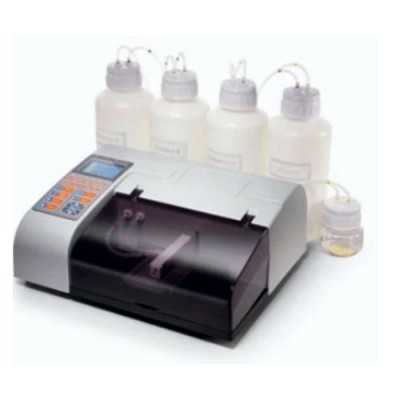
As a premier Microplate ELISA Reader Manufacturer, Supplier & Exporter in India, we provide state-of-the-art optical detection systems designed for high-sensitivity immunoassay analysis. Our 96-well plate readers utilize advanced interference filters and high-speed internal microprocessors to deliver precise optical density (OD) measurements. Engineered for both clinical diagnostics and pharmaceutical research, this automated ELISA system ensures accurate quantification of antigens, antibodies, and proteins, meeting international laboratory standards for reproducibility and data integrity.
Our India-made ELISA readers are vital for the detection of infectious diseases such as HIV, Hepatitis, and COVID-19. By facilitating high-precision absorbance microplate readings, they allow researchers to monitor hormonal imbalances, autoimmune markers, and cytokine levels with exceptional specificity.
Featuring a wavelength range of 400nm to 750nm, our readers process full 96-well plates in under 5 seconds. The integrated software supports linear and non-linear curve fitting, qualitative data interpretation, and seamless USB/RS232 PC connectivity for laboratory information system (LIS) management.
Beyond clinical pathology, these immunoassay analyzers are essential in food safety for allergen testing, agricultural pesticide detection, and environmental monitoring. They serve as a primary choice for biotechnology firms and university research centers worldwide.
We are a reliable Microplate ELISA Reader Exporter to the USA, UK, UAE, Germany, Australia, and 50+ nations. Our domestic supply network ensures delivery across Maharashtra, Gujarat, Delhi NCR, Tamil Nadu, and Karnataka.
Active Hubs: Mumbai, Bangalore, Ahmedabad, Chennai, Kolkata, Hyderabad, Delhi NCR, Pune, Jaipur, Lucknow, Gurgaon, Noida, Surat, Vadodara.
Q1: What wavelengths does the reader support?
Our 96-well plate readers come standard with filters for 405nm, 450nm, 492nm, and 630nm, with options for custom filters within the 400-750nm spectrum.
Q2: Can it handle different plate types?
Yes, it is compatible with standard 96-well microplates (flat, U, or V-bottom) and features an automated plate transport system for precise positioning.
Q3: What software features are included?
The system includes built-in software for absorbance quantification, curve fitting (point-to-point, linear regression), and qualitative analysis (cut-off value calculation).
Q4: What is the reading precision?
The reader provides a resolution of 0.001 Abs with a high signal-to-noise ratio, ensuring accuracy even at very low optical densities.
Looking for a high-performance ELISA Reader?