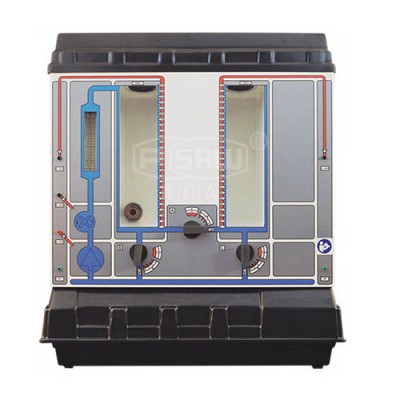
Mastering the logic of stability and feedback. As a leading Control Engineering Lab Equipment Manufacturer in India, PSAW provides research-grade Ball and Beam Apparatus, Coupled Tank Systems, and Servo Trainers for the automated future.
In an era of high-speed robotics and autonomous machines, the precision of a feedback loop is the difference between operational success and mechanical failure. Control engineering is the invisible thread that stabilizes aircraft in turbulence and regulates temperature in massive refineries. At PSAW, we take pride in being a premier Control Engineering Lab Equipment Supplier in India, offering apparatus that transforms abstract state-space equations into tangible, visible mechanical responses.
Our laboratory solutions, such as the Coupled Tank System and PID Training Rigs, are meticulously engineered to meet the demands of Industry 4.0. We provide Digital Interfaces that integrate seamlessly with MATLAB and LabVIEW, allowing students in India and abroad to analyze Bode plots, Nyquist stability, and root locus behavior in real-time. As a global Exporter of Control System Trainers, we enable technical institutions to simulate complex non-linear behaviors using our Ball and Beam and Ball and Hoop units.
Whether it is mastering the precision of a Servo Trainer for robotic limb movement or analyzing the time-lag in Thermal Process Control, our equipment is designed for durability and diagnostic accuracy. By manufacturing these sophisticated systems in India, PSAW ensures that engineering universities have the tools to produce innovators who can design the self-regulating industrial ecosystems and smart cities of tomorrow.
Used to study autopilot stability and missile trajectories. Our Feedback Control Trainers are essential for teaching flight stabilization logic.
Focus on precision position control. Our Servo Trainers simulate the exact actuators used in high-speed industrial robotic assembly lines.
Utilizing Coupled Tank Systems, engineers learn to manage multivariable interactions and maintain steady-state levels in complex refineries.
USA, UK, UAE, Germany, Australia, Canada, Singapore, Saudi Arabia, France, Japan, South Africa, Malaysia, Vietnam, Thailand, Kenya, Nigeria, Italy, Spain, Turkey, Indonesia, South Korea, Iraq, Oman, Kuwait, Qatar, and 85+ nations.
Maharashtra, Gujarat, Delhi NCR, Tamil Nadu, Karnataka, West Bengal, Punjab, Haryana, Uttar Pradesh, Rajasthan, Telangana, Kerala, Mumbai, Pune, Ahmedabad, Bangalore, Kolkata, Hyderabad, Lucknow, Indore, Baddi, and beyond.
Yes, our Coupled Tank Apparatus includes manual and solenoid-controlled drain valves to simulate real-world disturbances for testing the robustness of PID control loops.
Our Digital Data Acquisition units support various APIs, making them compatible with Python, MATLAB, and LabVIEW for advanced algorithm implementation.
© PSAW Laboratory Equipments - Manufacturer, Supplier & Exporter of Control Engineering Lab Equipment in India.