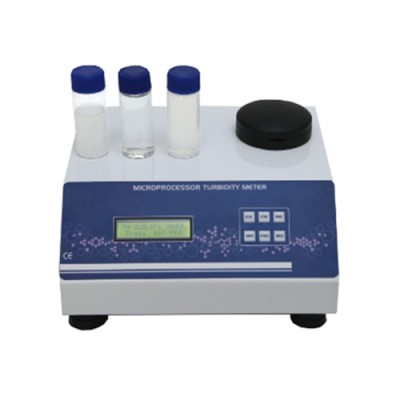
The Digital Turbidity Meter is a high-precision analytical instrument designed to measure the clarity of liquids by quantifying the concentration of suspended particles in a sample. Utilizing the nephelometric principle, this device measures the light scattered at a 90-degree angle to the incident beam, providing accurate readings in Nephelometric Turbidity Units (NTU). Our microprocessor-based turbidity meters are engineered for exceptional stability and sensitivity, featuring long-life infrared or tungsten light sources and high-sensitivity photodiodes. With a broad measuring range and automatic range selection, these instruments are essential for ensuring water quality across various sectors. The rugged design combined with a digital interface allows for rapid data acquisition, making it the benchmark for laboratory research and field-based environmental monitoring. Whether testing drinking water, industrial effluents, or chemical suspensions, our turbidity meters deliver the reliability and precision required for strict regulatory compliance and scientific integrity.
Turbidity meters are extensively applied in Municipal Water Treatment plants for monitoring raw and treated water quality. In the Food and Beverage industry, they are vital for ensuring the clarity of juices, wines, and soft drinks. The Pharmaceutical sector utilizes these meters for testing the purity of process water and the concentration of emulsions. Furthermore, environmental agencies rely on them for monitoring river health and sediment transport, while chemical manufacturing industries apply them to control the quality of pigments, polymers, and cooling tower water to prevent equipment fouling and ensure product consistency.
This instrument is primarily used for the routine checking of water samples to determine if they meet safety guidelines for turbidity. It is utilized in laboratory settings for studying the settlement rates of suspended solids and the effectiveness of flocculation and coagulation processes. Research scientists use turbidity data to characterize the properties of colloids and nanoparticles in suspension. It is also an essential tool in educational labs for demonstrating light scattering principles and in industrial laboratories for the standardization of liquid products where clarity is a primary quality parameter.
USA United Kingdom UAE Germany Australia Canada Singapore Saudi Arabia France Japan South Africa Russia Brazil Malaysia Vietnam Thailand Kenya Nigeria Egypt Italy Spain Mexico Turkey Indonesia Philippines South Korea Iraq Oman Kuwait Qatar Israel Norway Sweden Switzerland Poland Netherlands Peru Chile Argentina Portugal Greece Ireland Hungary Romania Vietnam Morocco Cambodia Tanzania Algeria Uzbekistan Kazakhstan Ethiopia Ghana Sri Lanka Nepal Bhutan Bangladesh Myanmar.
Maharashtra Gujarat Delhi NCR Tamil Nadu Karnataka West Bengal Punjab Haryana Uttar Pradesh Rajasthan Telangana Kerala Bihar Odisha Madhya Pradesh Indore Baddi Sikkim Goa Chhattisgarh Mumbai Pune Ahmedabad Surat Vadodara Chennai Bangalore Kolkata Jaipur Hyderabad Lucknow Kanpur Nagpur Coimbatore Ludhiana Chandigarh Ambala Gurgaon Noida Ghaziabad Varanasi Patna Jamshedpur Guwahati Ranchi Dehradun.