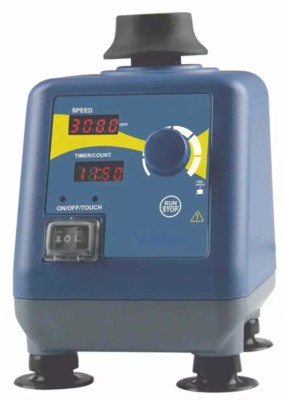
As a leading Vortex Mixer Manufacturer & Exporter in India, we provide high-frequency oscillation instruments engineered for rapid homogenization. The Laboratory Vortex Mixer is essential for mixing reagents within vials, test tubes, and microcentrifuge tubes. Operating on a precision-eccentric mechanism, our Variable Speed Vortexers generate a vigorous circular motion to homogenize samples in seconds. Our range includes Fixed Speed Vortex Mixers for routine tasks and Digital Vortex Mixers with Timers for sensitive assays. Built with heavy-duty zinc-die casting bases to prevent walking, these mixers feature silicon rubber caps for optimal friction. Whether for cell resuspension in molecular biology or reagent preparation in analytical chemistry, our India-made Laboratory Shakers deliver the mechanical consistency required for professional research environments.
A high-performance Chemical Reagent Mixer achieves total homogenization that manual shaking cannot replicate. In genomic research, uniform resuspension of DNA pellets is critical for PCR and sequencing. Our High Frequency Vortexers ensure identical chemical concentrations throughout the liquid, preventing localized reaction pockets. By utilizing precision-engineered oscillation, this Molecular Biology Mixer minimizes contamination risks and provides a standardized environment essential for repeatable scientific experiments.
Our Microcentrifuge Tube Mixers are used for quick pellet resuspension in cell culture. In chemistry, they dissolve solids in liquid solvents before analysis. Pathology labs use them for homogenizing blood samples, while forensic labs rely on them for extracting biological material. The Touch Start Vortex Mixer feature is designed for rapid individual tube mixing, while the continuous mode serves laboratories requiring constant agitation for chemical synthesis. As a Professional Mixer Manufacturer, we ensure these units excel in enzyme reactions, RNA resuspension, and protein assays.
These systems are vital in the Pharmaceutical industry for drug formulation and the Biotechnology sector for protein purification. Food and Beverage industries apply Vortex Mixing for testing additives, while environmental labs use them for analyzing water pollutants. Furthermore, they are essential Diagnostic Laboratory Mixers for routine patient testing and academic teaching of chemical reaction preparation.
USA UK UAE Germany Australia Canada Singapore Saudi Arabia France Japan South Africa Russia Brazil Malaysia Vietnam Thailand Kenya Nigeria Egypt Italy Spain Mexico Turkey Indonesia Philippines South Korea Iraq Oman Kuwait Qatar Israel Norway Sweden Switzerland Poland Netherlands Peru Chile Argentina Portugal Greece Ireland Hungary Romania Vietnam Morocco Cambodia Tanzania Algeria Uzbekistan Kazakhstan Ethiopia Ghana Sri Lanka Nepal Bhutan Bangladesh Myanmar Maldives Philippines Zambia Mauritius Jordan Sudan Kenya Ethiopia Uganda Libya Tunisia Lebanon Yemen Oman Kuwait Qatar Bahrain.
Maharashtra Gujarat Delhi NCR Tamil Nadu Karnataka West Bengal Punjab Haryana Uttar Pradesh Rajasthan Telangana Kerala Bihar Odisha Madhya Pradesh Indore Baddi Sikkim Goa Chhattisgarh Mumbai Pune Ahmedabad Surat Vadodara Chennai Bangalore Kolkata Jaipur Hyderabad Lucknow Kanpur Nagpur Coimbatore Ludhiana Chandigarh Ambala Gurgaon Noida Ghaziabad Varanasi Patna Jamshedpur Guwahati Ranchi Dehradun Haridwar Vishakhapatnam Kochi Madurai Raipur Bhopal Srinagar Jammu Aurangabad Mysore Solapur.