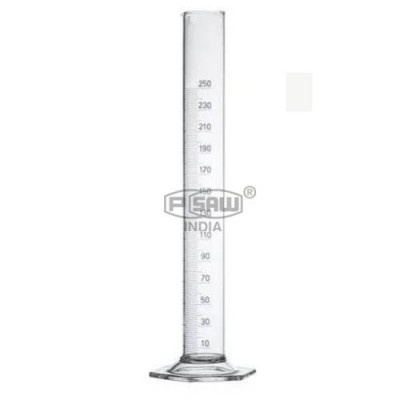
Our range as a Laboratory Measuring Cylinders Manufacturer in India includes high-grade Borosilicate 3.3 glass and premium Polypropylene. These cylinders are calibrated with precision to ensure that Chemistry Laboratory Instruments meet the strict tolerance levels required for analytical research. With clear, permanent amber or blue graduations, our products prevent parallax errors, making us the preferred Laboratory Measuring Cylinders supplier in India for global research facilities.
The significance of high-quality Laboratory Glassware Suppliers in Indiacannot be overstated. Accurate volume measurement is the backbone of scientific discovery. As an established Cylinders Exporter in India, we ensure our cylinders feature a heavy base for stability and a pour spout designed to eliminate dripping. This attention to detail is what defines professional Laboratory Measuring Cylinders Scientific Lab Equipment, ensuring safety and precision in every drop. Our Soda Glass Tubing and Gas Jar Glass options further complement a complete College Chemistry Lab Setup.
Our products are essential for Chemistry Lab Equipment portfolios. They are used for measuring liquid volumes, mixing chemicals, and performing precise dilutions. As a Laboratory Apparatus Manufacturer, we cater to biology, chemistry, and physics labs worldwide.
Used extensively in Chemistry Practical Lab Instruments for acid-base titrations, molar solution preparation, and qualitative analysis. Our Research Laboratory Equipment range is designed to withstand aggressive chemical reactions without compromising integrity.
Global Reach: USA, UK, UAE, Germany, Saudi Arabia, France, Australia, Canada, South Africa, Egypt, Nigeria, Kenya, Brazil, Mexico, Thailand, Malaysia, Singapore, Indonesia, Vietnam, Philippines, Russia, Turkey, Italy, Spain, Netherlands, Iraq, Iran, Bangladesh, Sri Lanka, Nepal, Oman, Kuwait, Qatar, Jordan, Ethiopia.
Domestic Supply (India): Maharashtra, Gujarat, Karnataka, Tamil Nadu, West Bengal, Uttar Pradesh, Delhi, Haryana, Punjab, Rajasthan, Madhya Pradesh, Kerala, Andhra Pradesh, Telangana, Bihar, Odisha, Mumbai, Pune, Bangalore, Chennai, Hyderabad, Ahmedabad, Kolkata, Gurgaon, Noida, Chandigarh, Lucknow, Indore, Jaipur, Patna, Bhopal, Visakhapatnam, Surat, Vadodara, Nagpur, Coimbatore.