

In modern quantitative chemical analysis, the spectrophotometer stands as one of the most fundamental analytical instruments across research laboratories, pharmaceutical quality control units, and industrial testing facilities. A spectrophotometer is an optical device designed to measure how much light intensity a chemical substance absorbs as a beam of light passes through a liquid sample. By measuring the light transmitted or absorbed at specific monochromatic wavelengths, scientists can precisely determine the identity, chemical purity, and exact quantitative concentration of unknown solute molecules.

From identifying trace heavy metals in environmental water samples to verifying nucleic acid (DNA/RNA) purity in genomic research, spectrophotometry provides rapid, non-destructive, and highly reproducible data. Leading scientific instrument manufacturers like PSAW India (Popular Science Apparatus Workshops) have refined these optical systems, making high-precision benchtop spectrophotometers accessible for academic institutions, clinical diagnostic centers, and industrial quality control units nationwide.
A spectrophotometer works on the Beer-Lambert Law, which states that the optical absorbance ($A$) of a chemical solution is directly proportional to its solute concentration ($c$) and the light path length ($b$). The instrument passes a specific monochromatic light wavelength through a cuvette containing the sample, and a photodetector quantifies the transmitted light intensity ($I$) compared to the initial incident light intensity ($I_0$).
Primary types include Single Beam, Double Beam, UV-Vis, FTIR (Fourier Transform Infrared), Atomic Absorption (AAS), and Microvolume Spectrophotometers. Key applications range from molecular biology assays (DNA/RNA/Protein quantification) to pharmaceutical purity testing, water quality monitoring, and clinical diagnostic assays.
The operational mechanism behind spectrophotometric quantitative analysis rests on the interaction between electromagnetic radiation and chemical matter. When a beam of light with a specific wavelength passes through a liquid solution, the dissolved solute molecules absorb a portion of the photon energy, exciting their valence electrons to higher energy orbitals.
+--------------+     +---------------+     +--------------------+     +---------------+     +--------------+
| Light Source | --> | Monochromator | --> | Incident Light (I?)| --> | Sample Holder | --> | Photodetector|
| (Deuterium / |     | (Prism/Grating|     | Monochromatic      |     | (Cuvette)     |     | (PMT/Photodiode)
|  Tungsten)   |     |   + Slit)     |     | Wavelength)        |     |               |     |              |
+--------------+     +---------------+     +--------------------+     +---------------+     +--------------+
                                                                             |
                                                                             v
                                                                    Transmitted Light (I)
The fundamental mathematical equation governing spectrophotometry combines Beer's Law (absorbance is proportional to concentration) and Lambert's Law (absorbance is proportional to path length):
Where:
Transmittance (T) represents the fractional ratio of light that passes through the sample without being absorbed:
Absorbance (A) is the logarithmic ratio of initial light intensity to transmitted light intensity:
When 100% of light passes through a blank reference solution, Transmittance is 1 and Absorbance is 0. As the chemical concentration increases, more light photons are absorbed, decreasing Transmittance exponentially while increasing Absorbance linearly.
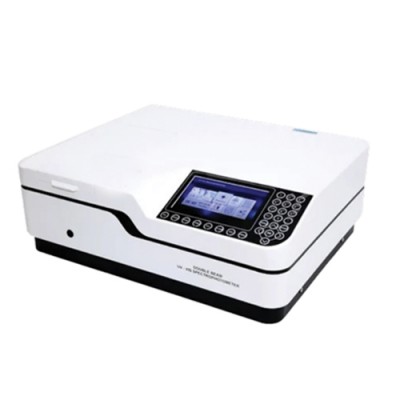
To deliver accurate photometric readings, an optical spectrophotometer relies on five essential internal hardware assemblies:
Depending on optical design, light paths, and target spectral ranges, spectrophotometers are categorized into distinct analytical types:
| Spectrophotometer Type | Optical Mechanics & Features | Primary Laboratory Applications |
|---|---|---|
| UV-Vis Spectrophotometer | Measures absorption across Ultraviolet (190 nm to 380 nm) and Visible (380 nm to 780 nm) wavelengths. | Nucleic acid purity, protein assays, chemical concentration testing. |
| Single Beam Spectrophotometer | Employs a single optical light path. Requires manual calibration using a blank reference before every sample reading. | Routine educational experiments, basic quantitative analysis, cost-effective testing. |
| Double Beam Spectrophotometer | Splits light beam into two paths (sample and reference simultaneously), auto-correcting lamp drift. | High-precision research, time-course kinetic studies, complex matrix analysis. |
| FTIR Spectrometer (Fourier Transform Infrared) | Measures mid-to-far infrared absorption using an interferometer and Fourier transform calculations. | Identifying functional groups, organic compound structural verification, polymer testing. |
| Atomic Absorption Spectrophotometer (AAS) | Atomizes liquid samples using flame/furnace to absorb element-specific light frequencies. | Detecting trace heavy metal concentrations (Lead, Mercury, Cadmium) in environmental testing. |
| Microvolume Spectrophotometer (NanoDrop / Bio-Nano) | Uses surface tension to hold 1 µL to 2 µL micro-droplets without cuvettes. | High-throughput genomics, molecular biology, micro-sample nucleic acid quantification. |
Spectrophotometry plays a major role across scientific, diagnostic, and industrial sectors:

A colorimeter measures light absorbance in fixed visible light wavelengths using optical color filters, making it suitable only for colored solutions. A spectrophotometer uses a monochromator to isolate individual, continuous monochromatic wavelengths across both Ultraviolet (190 nm to 380 nm) and Visible (380 nm to 780 nm) spectrums, providing higher optical resolution and precision.
Standard glass and plastic cuvettes absorb ultraviolet light below 340 nm, which causes significant interference and inaccurate absorbance readings. Optical quartz cuvettes remain transparent down to 190 nm, allowing unhindered UV light transmission for DNA, RNA, and protein measurements.
The A???/A??? ratio is an optical test used to evaluate nucleic acid purity relative to protein contamination. Nucleic acids absorb maximally at 260 nm, whereas aromatic amino acids in proteins absorb maximally at 280 nm. Pure DNA exhibits a ratio of ? 1.8, while pure RNA exhibits a ratio of ? 2.0. Lower values indicate residual protein or phenol contamination.
A single beam spectrophotometer passes a single optical light path through one sample holder at a time, requiring manual baseline zeroing with a reference blank before every measurement. A double beam spectrophotometer splits the light beam into two simultaneous paths (one passing through the reference blank and one through the sample), automatically canceling out source intensity fluctuations and optical drift in real time.

For educational institutions, chemical research facilities, and medical diagnostic laboratories looking for durable analytical equipment, PSAW India (Popular Science Apparatus Workshops) provides a broad range of high-performance digital, UV-Vis, single beam, and double beam spectrophotometers engineered for accuracy and reliable long-term operation.
Explore durable, high-accuracy digital and UV-Vis spectrophotometers engineered for academic, diagnostic, and research applications.
Enquire Now